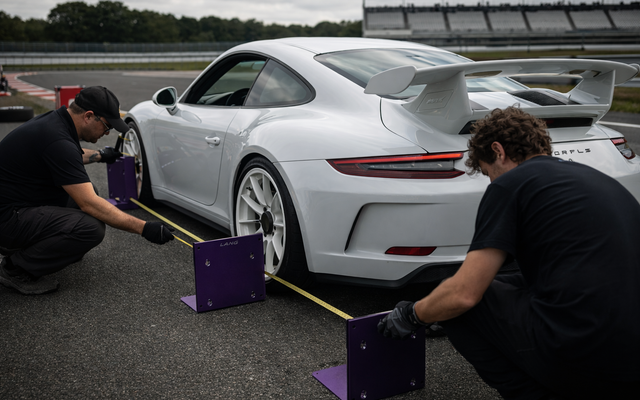
Within the high-stakes arena of contemporary serious sliding, podium finishes is no longer exclusively a result of raw torque or pilot bravado. Rather, it is now a complex discipline which necessitates a meticulous marriage of picking a proven vehicle platform, arming it with the highest-quality performance parts, and, most essentially, understanding its real-time characteristics on the course through advanced vehicle dynamics analysis tools. This definitive manual will serve as your blueprint starting from the initial concept of a project car right through to the last engineering-refined adjustments that transform a capable car into a repeatable champion. We will examine in detail the art and science of vehicle alignment optimization, illustrating how a state-of-the-art drift tuning app like precise measurement hardware eliminates guesswork and provides unparalleled insight into your vehicle's true performance.
The bedrock of any successful drift car is, undoubtedly, the platform itself. A select group of cars have earned iconic status within the global drifting community due to their inherent balance, durable construction, and the enormous availability of specialist parts available. Choosing the correct platform is the first and most crucial selection a enthusiast will make. For instance, the BMW's E36 3 Series is commonly accepted as perhaps the the greatest all-around drift cars of history. Its almost ideal evenly distributed mass, alongside a rear-wheel-drive layout and bulletproof inline-six engines, creates a platform that is simultaneously accessible for novices and extremely competitive in the control of a pro pilot. The next step of this philosophy, the BMW E46, improves on these qualities with a more sophisticated structure, increased track for improved high-speed stability, and yet more lock as standard from the OEM. Another powerful platform in the top-level scene is the Chevrolet Corvette C6.
This V8-powered track weapon offers a unique array of strengths to the sideways world, such as a lightweight aluminium structure, a transaxle-style drivetrain component that aids in an perfect weight distribution, and the tremendous torque of a big GM LS engine. This combination renders it an complete monster on track, designed of initiating and holding continuous drifts with apparently minimal use of acceleration. For builders seeking remarkable bang-for-the-buck, the Nissan 350Z excels as a prime candidate. It comes from the manufacturer with a rigid chassis, a competent original LSD, and the free-revving VQ35DE powerplant that delivers ample performance for learning and progressing in the activity. Its successor, the 370Z model, offers additional improvements in body strength, handling precision, and outright engine power, solidifying its position as a common pick among professional pilots. Other legendary platforms that deserve consideration encompass the nimble Wankel-engined FC generation RX-7, the ever-present Nissan S13 240SX, the torque-rich Ford Mustang SN95, the modern BMW E90, and the compact yet unbelievably engaging and teachable Mazda MX-5. Every single one of these platforms offers a different palette of traits, challenges, and possibilities, but they all have in common the fundamental elements necessary to serve as a capable drift car.
However, choosing the right platform is merely the beginning. To release the full potential of every of these vehicles, substantial changes to the steering and chassis control systems are absolutely mandatory. This is where the realm of performance drift-spec components enters critical importance. The most most transformative upgrade for a serious drift machine is the integration of a high-performance drift angle kit. These engineered systems, for example those engineered by specialist companies like SLR Speed, are created to significantly increase the vehicle's available turning lock. A OEM production vehicle is extremely restricted in how far its front wheels can pivot, a safety trade-off for public road use. In drifting, but, maximum countersteering is continuously required to manage and hold a slide. An modification kit substitutes the OEM steering knuckles, tie rods, and sometimes suspension arms with pieces that allow the steered wheels to reach angles beyond 70 or even 80 degs, as opposed to a average OEM angle of around 40 to 50 degrees.
This immensely increased capability provides the pilot with exponentially greater authority during a slide, enabling it to be far more straightforward to start a slide, hold it through a sweeping turn, and switch smoothly from one direction to the opposite. The improvement in controllability is absolutely revolutionary. Combined with a properly specified modification is the every bit as vital modification to the vehicle's suspension. Off-the-shelf or including premium street dampers are just not designed for the particular and harsh needs of drifting. A drift-spec pair of coilovers is paramount. These engineered suspension components incorporate unique valving and spring stiffness that are tuned for the rapid weight transfer that is inherent of aggressive driving. When a driver starts a slide, the car's weight is transferred violently to the front of the bend. Proper performance coilovers control this transfer in a controllable fashion, allowing the chassis to find its balance rapidly and offering the pilot precise feel through the steering wheel and driver's seat. They furthermore enable exact adjustment of ride height, damping stiffness, and cross-weight, which are all key parts of dialing in the chassis's dynamics to a given venue or driving technique. In combination, a high-quality angle modification system and a correctly chosen set of competition coilovers form the core hardware foundation upon which all subsequent tuning is constructed.
Once the core hardware is installed, the subsequent vital phase in the build is the precise setting of the chassis's alignment. This is the realm of vehicle alignment optimization, a methodology that can feel overwhelmingly complex to the beginner but is, in reality, the defining factor to transforming a collection of fast pieces into a harmonious and consistent machine. The most critical element of suspension geometry for sliding is certainly camber angle. Camber is the inclination of the rim relative to the vertical axis when viewed from the forward of the car. If the upper part of the tire is tilted towards the chassis, this is referred to as inward tilt. In sliding, an inward tilt on the front wheels is widely used and is regarded as essential. The reason is deeply tied to physics.
When a chassis is turning at extreme sideways angles, the frame leans toward the external of the corner. This body roll makes the outside front wheel to reduce its optimal grip area with the asphalt. By adding negative camber, the wheel is pre-tilted to account for this lean. As the chassis rolls into the corner, the outside front tire becomes more upright with the track, optimizing its traction at the critical time when it is needed most for directional command. Typically, front axle camber settings for a serious drift car fall between approximately -3 degrees to as much as -5 degrees or even greater, depending on the details of the chassis configuration, compound selection, and operator preference. The rear axle wheels also employ negative camber, but the angles are usually more modest and less aggressive than the front. Too much camber at the rear can result in the chassis overly tail-happy and hard to control on throttle input, as it reduces the available grip area of the driving tires during linear acceleration. Thus, rear axle camber settings are frequently in the vicinity of -1 degree to -3 degrees, achieving a delicate compromise between giving enough cornering bite to aid in initiating and maintaining the angle while still preserving good grip for exiting the corner. Camber is only one part of the more complex alignment picture, which additionally encompasses toe setting, caster, and bump steer adjustment.
Toe angle is the orientation of the tires when looked at from above. Toe-in means the front edges of the wheels are closer together than the rear edges, while outward toe means the reverse. For oversteer, a modest amount of front axle negative toe is often used to quicken the turn-in handling reaction, making the vehicle feel more nimble and willing to start a drift. Rear axle toe setting is usually set to neutral or a extremely small amount of inward toe to encourage predictability under power. caster angle is the frontwards or backwards angle of the kingpin axis when looked at from the side-on of the car. Increased positive caster improves feedback and high-velocity confidence, and it also increases negative camber effect during steering, which is highly useful. Setting these settings is a intricate suspension engineering interplay where a change to a single value can and often will impact the others. The traditional process for setting a vehicle's alignment for drifting has historically been a labor-intensive affair of guesswork and adjustment. A driver or engineering group would introduce a adjustment based on experience, run the chassis on track, use the driver's individual sensation and comments, and then make an additional change. This cycle would iterate again and again until the car felt "acceptable" or the scheduled practice period was exhausted. This methodology is not only exceptionally slow in terms of hours and resources, but it is additionally deeply imprecise.
Human perception is a famously subjective metric, affected by many factors such as tiredness, changing track conditions, weather, and just the mindset of the operator on that given day. What feels "loose" on one run might feel "pushing" on the following pass, causing contradictory data and ineffective adjustments. This traditional challenge in vehicle dynamics optimization is exactly where modern telemetry systems has stepped in to completely change the process.
The advent and application of specialized vehicle dynamics tools has brought about a radically different era for building and perfecting professional sliding vehicles. These platforms, exemplified by groundbreaking solutions like modern telemetry hardware, operate by actively recording the real-time dynamic performance of the vehicle as it is operated on the circuit. Unlike depending on subjective feedback, these systems acquire objective information on critical factors such as shock absorber movement, corner velocities, lateral and longitudinal g-forces, steering angle, and throttle and brake position. This acquired information flow is then analyzed by advanced algorithms that can plot and interpret the information in a actionable format. For the very first time, engineers and crews can observe precisely what the chassis is doing at every point of a drift. This ability changes the complete chassis setup process. Think about the particular goal of optimizing the front axle camber for a given car. Rather than making a adjustment from -3 degrees to -3.5 degrees and then running many runs to try and "feel" a change, a suspension tuning tool can give immediate and irrefutable information. The tool can indicate in a chart how the wheel's loading is behaving during the most important phases car suspension tuning of a slide: the initial flick, vehicle dynamics tool sustain, and changing direction. It can reveal if the current angle is allowing the steering tire to keep maximum contact or if the compound is overloaded on its outer shoulder.
The software can subsequently provide data-driven recommendations for modification. Perhaps the telemetry indicates that the tire is even overworking its edge at -3.5 degrees of camber, suggesting that a move towards inward lean, say -4 degrees, might be advantageous. Conversely, the information might indicate that the tire is failing to achieving optimal operating temp or that the inner edge is wearing too quickly, which could suggest that there is overly aggressive angle and a small reduction back to -3.2 degrees would be more ideal. This level of granularity and useful analysis was literally unimaginable in the time of solely mechanical adjustment.
The effect of employing a advanced suspension tuning tool reaches well beyond merely setting camber. It functions as an priceless coilover setup tips that is customized to your exact vehicle. When adjusting the shock absorber settings on your suspension, instead of using vague guidelines or copying another car's setup, you can utilize the telemetry to observe how the car is performing in response to your tweaks. The software can display the suspension travel path over a lap, showing if the coilovers are controlling the chassis motion effectively or if they are permitting the vehicle to oscillate uncontrollably after a transition. It can assist in pinpointing issues like hitting the bump stops or topping out, allowing you to introduce informed choices to helper springs, rebound/compression rates, or ground clearance. This approach applies just as well to the detailed task of suspension geometry optimization. In addition to camber angle, the system can give data into how modifications to toe and caster are impacting the vehicle's stability during various parts of a lap. For example, it can help you to ascertain the ideal amount of front axle negative toe for your specific steering rack configuration and competition approach by measuring the speed of initial response and the consistency of the vehicle at lock countersteer. This makes the system an incredibly effective performance optimization handbook that is constantly calibrated by the live performance of your own car on the track. It moves the entire process from a mysterious craft into a methodical optimization process.
Moreover, the value of a platform like modern telemetry is not at all restricted to expert tuners with extensive funding. For the club-level competitor, it functions as an amazing equalizer. It practically gives the driver with the knowledge of a professional dynamics engineer without the associated cost. It drastically shortens the tuning process by delivering definitive solutions to problems that would otherwise take seasons of experience to solve. A tuner can understand how their particular chassis behaves to specific adjustments, developing a deeper knowledge of suspension theory in the endeavor. It additionally democratizes professional performance tuning principles, allowing anyone with the ambition to optimize their car to accomplish it in a efficient and productive manner. This is notably valuable in a sport like drifting, where engineering expertise has traditionally been a closely guarded advantage among elite teams. Today, that knowledge can be in the toolkit of every dedicated builder.
In summary, the journey to engineering and tuning the ideal championship-contending drift car is a comprehensive endeavor that smoothly blends proven hardware principles with revolutionary digital tools. It begins with the wise selection of a capable chassis, then enhanced by the installation of essential performance hardware like maximum-angle steering angle kits and properly specified drift-spec adjustable dampers. The build then progresses into the precision realm of chassis dynamics adjustment, where parameters like camber angle, toe setting, and caster are precisely adjusted to match the car's upgraded geometry and the operator's specific technique. The final step, and what truly distinguishes the today's approach from the old ways, is the use of a sophisticated vehicle dynamics tool. This platform eliminates the uncertainty and trial and error of purely subjective setup by giving objective, real-time telemetry on how the chassis is really performing. It serves as an unparalleled engineering partner, a comprehensive coilover setup manual, and a comprehensive chassis development system. Together, this holistic approach guarantees that each and every component of the competition vehicle—from the selection of the chassis to the final adjustment on the coilover—is refined for peak success on the competition venue. It embodies the full evolution of the discipline of sliding, connecting mechanical pilot talent with data-informed vehicle setup to forge the perfect dominant vehicles attainable.